


What Are the Benefits of a 3D Matterport Virtual Tour?
Explore the benefits and limits of 3D Matterport virtual tours, compare them with photos and video, and decide when one suits an Ottawa property.
What Are the Benefits of a 3D Matterport Virtual Tour?
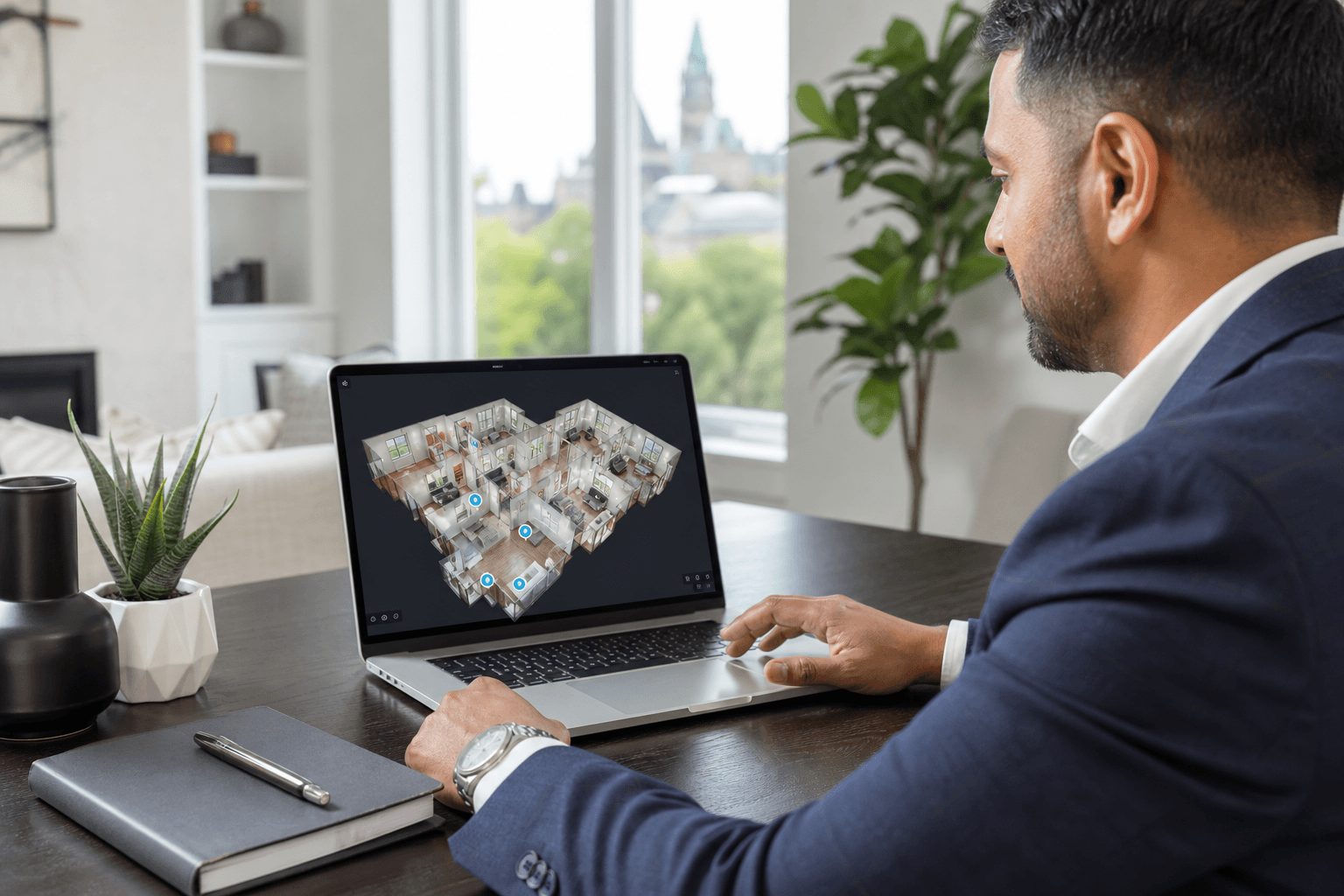
A 3D Matterport virtual tour gives buyers, tenants, investors, and commercial clients an interactive way to understand a property before deciding whether to arrange an in-person visit. Its main value is spatial context: viewers can explore how rooms connect and form a clearer initial impression than they may get from separate listing photos.
For an Ottawa property, a 3D tour is best treated as one part of a broader marketing or evaluation plan. It can support remote decision-making, but it does not replace a physical viewing, inspection, appraisal, legal advice, or another professional assessment. Matterport’s real estate materials also distinguish interactive 3D tours from simpler 360-degree walkthroughs, which is important when choosing the right format.
What a 3D Matterport virtual tour shows
A 3D Matterport virtual tour is an interactive digital representation of an interior or property. Rather than presenting only a selected sequence of images, it lets viewers move through available spaces in a self-directed way. Depending on how it is prepared and published, a viewer may be able to change direction, move between rooms, and examine how areas relate to one another.
That differs from a linear video walkthrough, where the viewer follows the route and pace chosen by the person recording it. A basic 360-degree tour provides panoramic views from selected points but may offer less connected spatial context. A Matterport-style tour is designed around exploration of the property as a connected environment.
Each format has a role. Photos can communicate finishes and details particularly well, video can show movement and atmosphere, and an in-person visit remains important when a decision depends on physical condition or sensory impressions.
1. It can make the property’s layout easier to understand

The clearest potential benefit is improved spatial understanding. Individual listing photos often show rooms in isolation. A viewer may see a kitchen, bedroom, hallway, or office without immediately understanding how those spaces connect. An interactive tour can help create a more complete mental model of the property.
This may be useful when layout is central to the decision, such as with a multi-level home, an unusual condo floor plan, a commercial unit with several work areas, or an investment property being reviewed by multiple people. Viewers can consider:
- How people move from the entrance to the main living or working areas
- Whether bedrooms, offices, washrooms, and storage areas suit the intended use
- How rooms connect and whether the arrangement appears practical
- Which areas require a closer in-person look
A digital tour is not a certified measurement or professional assessment. Perspective, camera placement, lighting, and screen size can affect how space appears. Dimensions and physical conditions should be confirmed through appropriate sources.
2. It can support more efficient remote pre-screening
Buyers, tenants, investors, and commercial occupants often need to decide whether a property deserves further attention before arranging a viewing. A 3D tour can provide more context for that early decision than a small selection of still images alone.
Someone relocating to Ottawa may use a tour to narrow a list before travelling. A tenant with a demanding schedule may use it to identify which rental properties merit a closer conversation. An investor or commercial prospect may share the tour with partners before deciding which questions to raise.
This does not guarantee fewer showings, faster transactions, or better marketing results. It simply gives a qualified viewer another way to evaluate the property during the pre-screening stage. People comparing residential property options in Ottawa or reviewing commercial opportunities may find that additional context useful.
3. It can improve access for busy or out-of-town clients
Scheduling becomes more complicated when people work different hours, live outside Ottawa, are relocating, or need to coordinate with family members and business partners. An interactive tour gives them a way to review a property on their own schedule before deciding whether an in-person visit is practical.
- Relocating buyers: They can become familiar with a layout before travelling to Ottawa or narrowing their search.
- Tenants: They can review a condo or home remotely before asking questions about availability, lease terms, or a viewing.
- Landlords and investors: They can share a consistent representation with people involved in a rental or investment decision.
- Commercial clients: Business owners, partners, and decision-makers can review a space even when they cannot all attend an initial visit.
Accessibility has limits. Not every viewer will have the same comfort with interactive technology, and a digital tour cannot reproduce every physical or sensory aspect of a property. It supports access to information; it does not eliminate the need for suitable physical review.
4. It can create reusable property content
A well-prepared interactive tour may remain useful beyond the first listing conversation. A seller or landlord may use it during preliminary discussions, while an investor or commercial client may revisit it when comparing properties or explaining a layout to another stakeholder.
The value is not a guaranteed increase in views, enquiries, or offers. Rather, it gives different viewers a consistent way to revisit the property’s spatial arrangement. That can be practical when several people need to review the same space at different times.
Its usefulness depends on how long the property remains materially unchanged. Renovations, repairs, furniture changes, occupancy changes, or a change in the areas being offered can make a tour less representative. Owners and representatives should consider how content will be maintained before relying on it over time.
5. It can provide a clearer view of layout and presentation
Because viewers can explore rather than follow only a predetermined sequence, a 3D tour may encourage more specific questions. A viewer may ask how rooms connect, whether a route appears workable, or which parts of the property need closer inspection.
That can support more informed conversations about presentation. A buyer may think about furniture placement, a tenant may consider daily movement, and a commercial user may assess whether the arrangement appears compatible with operations. An investor may use the tour to frame questions before discussing valuation, leasing, or management.
An interactive format is not automatically neutral. Decluttering, staging, lighting, camera placement, and the decision about which areas to include can influence perception. A tour should present the property accurately rather than create an impression that is difficult to reconcile with an in-person visit.
How does Matterport compare with photos, video, and 360-degree tours?
The most suitable format depends on what the viewer needs to learn. These are practical format distinctions, not measured performance advantages.
| Format | Viewer control | Main strength | Limitation |
|---|---|---|---|
| Listing photos | Low | Quickly communicates selected rooms, finishes, and features | May not show how spaces connect |
| Video walkthrough | Low to moderate | Shows a guided route, movement, and atmosphere | The viewer follows the recording path |
| Basic 360-degree tour | Moderate | Offers panoramic views from selected points | Connection between viewpoints may be limited |
| Matterport-style 3D tour | High | Supports interactive exploration of a connected layout | Requires preparation, accurate presentation, and current content |
Photos and video can complement a 3D tour rather than compete with it. A viewer may need close visual detail, a sense of movement, and a way to understand the floor plan. Choosing a format because it is technologically advanced is less useful than matching it to the property and audience.
What are the limitations of a 3D Matterport tour?
- Preparation takes effort. Rooms may need cleaning, decluttering, repairs, or arrangement before capture.
- Presentation affects perception. Lighting, staging, camera positioning, and coverage can influence how a property appears.
- Privacy requires attention. Documents, photographs, mail, valuables, keys, and identifying details should be reviewed before publication.
- Content can become stale. Renovations, repairs, furniture changes, vacancy, or altered available space may make a tour inaccurate.
- It cannot verify every physical condition. Odours, noise, temperature, tactile issues, hidden defects, and building systems may not be apparent digitally.
- It does not replace professional advice. A tour is not a substitute for an inspection, appraisal, legal review, financing advice, or another appropriate assessment.
These limitations clarify what the format is for: informed initial exploration and better questions, not final verification of every material fact.
Who is most likely to benefit from one?
A 3D tour may be worth considering when the layout is difficult to communicate through photos, several decision-makers need to review the property, or remote interest is likely.
Ottawa sellers
A seller may consider a tour for a multi-level home, unusual layout, or listing likely to attract buyers from outside the immediate area. The key question is whether spatial understanding justifies the preparation and ongoing content management.
Buyers and tenants
A tour can help buyers and tenants narrow options and prepare more useful questions before a viewing. It may be particularly helpful when comparing homes, condos, or rental properties remotely, but it should not support assumptions about conditions requiring physical confirmation.
Landlords and investors
Landlords and investors may use a tour when sharing a property with prospective tenants, partners, or advisers. It can support an initial discussion about layout and suitability, while tenant screening, valuation, investment analysis, and property management require additional information.
Commercial clients
A commercial tenant, buyer, or seller may consider a tour when multiple stakeholders need to understand a unit before arranging a site visit. Business use, access, building systems, zoning, lease terms, and other important matters still require separate review.
Sagar Shah Real Estate serves residential and commercial clients across Ottawa, including buyers, sellers, tenants, landlords, and investors. Its business information does not establish that it creates or scans Matterport tours, so owners should confirm who will provide the capture and how the content will be used.
Property preparation checklist before a 3D tour
- Declutter the areas being shown. Remove unnecessary items without hiding features viewers should reasonably see.
- Address visible presentation issues. Consider cleaning, lighting, minor repairs, and conditions that could distract from an accurate impression.
- Protect personal information. Put away documents, mail, family photographs, keys, valuables, and security-sensitive items.
- Confirm the coverage. Decide which rooms, storage areas, exterior spaces, or shared areas will be included.
- Plan access. Coordinate occupants, pets, tenants, business operations, and building requirements.
- Set a freshness plan. Decide what happens if the property is renovated, reconfigured, occupied differently, or offered with different areas later.
Preparation should support truthful representation, not create a digital version of the property that a viewer cannot reasonably encounter in person.
A simple decision test for an Ottawa property
- Does layout matter? If room relationships, circulation, scale, or access are central, an interactive format may add useful context.
- Will people evaluate remotely? Relocation, distance, conflicting schedules, or multiple stakeholders can make remote pre-screening more valuable.
- Will the property remain stable? If renovations, occupancy, staging, or available areas will change quickly, the content may have a short useful life.
- Can privacy and preparation be managed? If not, a simpler format may be more appropriate until the property is ready.
- What must still be verified in person? List condition, sound, access, measurement, building, and operational questions that a tour cannot answer.
If most answers point towards spatial context and remote review, a 3D tour may be worth considering. If the property is simple, the audience is local, or close-up detail matters more than navigation, photos or video may provide sufficient information.
The practical answer: consider the tour when spatial context matters
The main benefits of a 3D Matterport virtual tour are clearer spatial understanding, more convenient remote pre-screening, improved access for busy or out-of-town viewers, reusable property content, and more informed questions about layout and presentation. These are potential benefits, not guaranteed marketing outcomes.
The format is most useful when a property has meaningful spatial complexity or when buyers, tenants, investors, or commercial stakeholders need to review it remotely. It should be accurate, current, privacy-conscious, and combined with photos, conversation, in-person viewing, and professional verification where appropriate.
For Ottawa guidance on buying, selling, leasing, property valuation, or investment decisions, contact Sagar Shah Real Estate to discuss your residential or commercial property needs. The practice serves clients across Ottawa under the Right At Home Realty Brokerage.
Ready to discuss your real estate goals?
Get practical, personalized guidance for your next move in Ottawa.
Book a consultation